Veterinary Acupuncture: How It Works and When It May Help Your Pet
Veterinary Acupuncture: How It Works and When It May Help Your Pet
For someone who has never experienced acupuncture, the idea of placing tiny needles into a dog or cat may sound unusual.
Will it hurt?
Will my pet sit still?
What does acupuncture actually do?
And how could it possibly help?
At Prism Integrative Veterinary Health, acupuncture is one of several therapies we can incorporate into an individualized treatment plan.
Understanding how it works can help pet parents see why this centuries-old practice has a place within modern integrative veterinary medicine.
What Is Veterinary Acupuncture?
Acupuncture involves inserting very small needles into specific areas of the body known as acupuncture points.
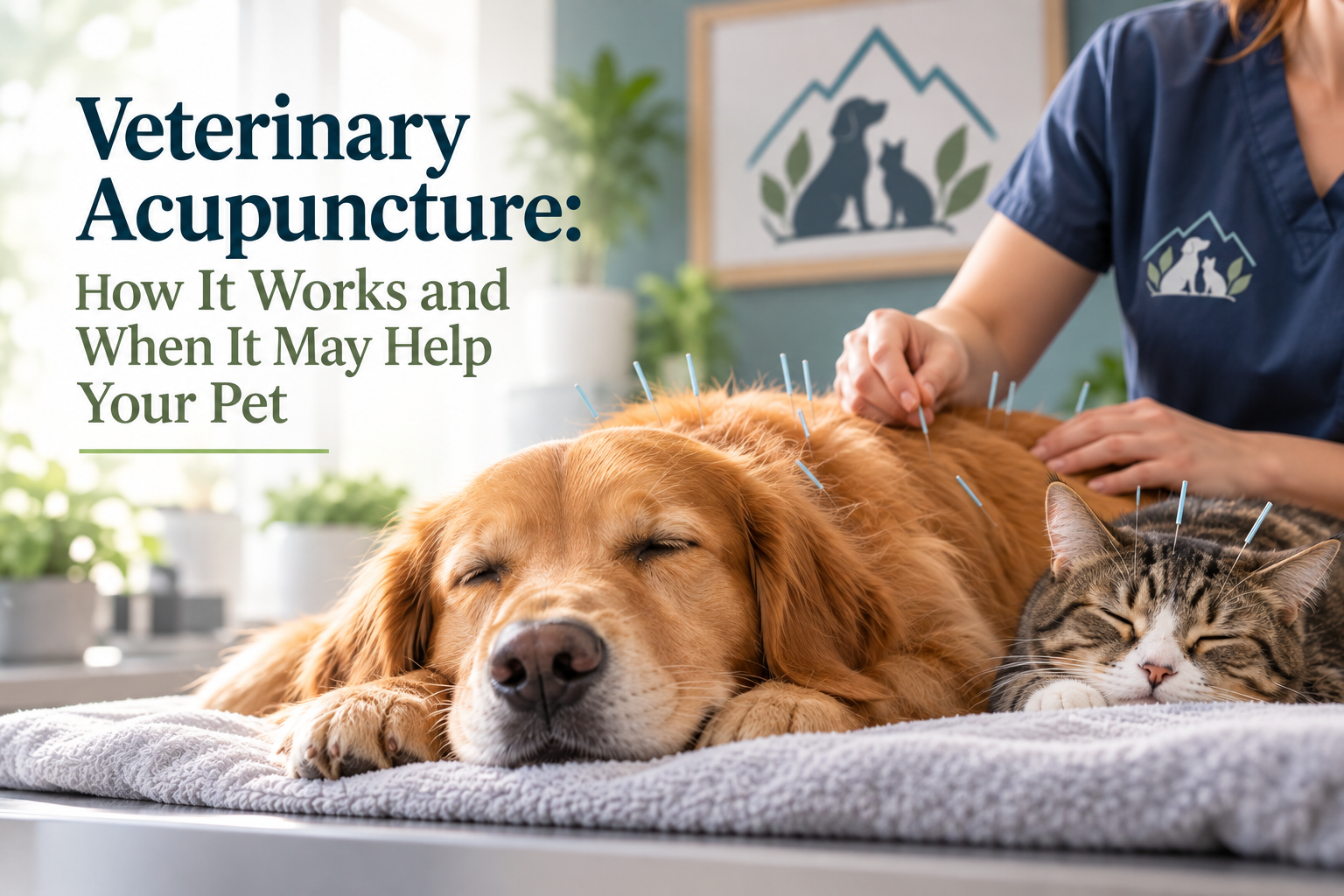
At Prism, the needles are placed superficially into the skin and connective tissue, and placement is rarely felt by the patient.
Many pets actually become very relaxed during their sessions, and some fall asleep.
How Does Acupuncture Work?
Acupuncture can be understood from both Traditional Chinese Medicine and Western medical perspectives.
In Traditional Chinese Medicine, acupuncture points exist along pathways called meridians, and treatment is intended to support the balanced movement of energy, or Qi.
From a Western perspective, stimulation of acupuncture points affects the nervous system and can influence blood flow, inflammation, and the release of naturally occurring pain-relieving and relaxing compounds.
These different frameworks give us two ways of understanding the same therapeutic tool.
Acupuncture for Pain and Mobility
Pain and mobility concerns are common reasons pet parents become interested in acupuncture.
An older dog may be slowing down.
A pet with arthritis may hesitate on stairs.
Another patient may have muscle tension or discomfort associated with a musculoskeletal problem.
Acupuncture can be incorporated into a larger plan designed around the individual patient's condition and mobility goals.
Acupuncture Doesn't Have to Work Alone
One of the advantages of integrative veterinary medicine is that we aren't limited to one modality.
A pet experiencing mobility problems may benefit from a plan that considers:
- Acupuncture
- Spinal manipulation
- Cold laser therapy
- Weight management
- Nutrition
- Appropriate exercise
- Conventional medication when indicated
Prism also offers spinal manipulation for concerns such as stiffness, reduced range of motion, postural imbalance, mobility problems, and chronic musculoskeletal discomfort.
The goal isn't to select the most “natural” option.
It's to determine which combination makes sense for that particular patient.
What Happens During an Acupuncture Appointment?
Treatment begins with the patient—not the needles.
Your veterinarian considers the pet's medical history, current concerns, physical findings, and goals before determining whether acupuncture is appropriate and which points may be used.
Needles are then gently placed at selected points.
How frequently a pet needs treatment and how long benefits last can vary based on the patient's condition.
Will My Pet Tolerate Acupuncture?
This is one of the most common concerns pet parents have.
Fortunately, acupuncture needles are extremely small, and Prism notes that most patients find treatment relaxing.
Every pet is still an individual.
Our priority is creating an experience that works with the patient rather than forcing treatment.
Is Acupuncture Only for Senior Pets?
No.
Although aging pets with pain and mobility concerns may benefit from integrative therapies, acupuncture isn't defined by a patient's age.
Whether it belongs in a treatment plan depends on the condition we're addressing, the individual patient's health, and what we're trying to accomplish.
Acupuncture Is One Tool in the Toolbox
Acupuncture isn't a replacement for diagnostics.
If a dog suddenly begins limping, for example, our first priority isn't simply placing acupuncture needles.
We need to understand why the dog is limping.
Integrative medicine means combining appropriate diagnostics with a broader selection of treatment options.
That distinction is important.
Veterinary Acupuncture at Prism
At Prism Integrative Veterinary Health in Tinton Falls, acupuncture is part of a much larger whole-patient approach.
Our doctors combine conventional veterinary medicine with therapies such as acupuncture, spinal manipulation, nutrition, herbal support, advanced diagnostics, and other integrative modalities based on the needs of the individual patient.
If you've been wondering whether acupuncture could become part of your pet's care plan, the first question isn't simply “Does acupuncture work?”
It's:
“Is acupuncture an appropriate tool for what my pet needs?”
That's the question an individualized veterinary plan can help answer.